A low cold email reply rate can be a data problem before it’s a copy problem.
TL;DR
Instantly.ai’s 2026 Cold Email Benchmark Report puts the average cold email reply rate at 3.43%, the top 25% of senders at 5.5% or higher, and the top 10% (“elite” senders) at 10.7% or higher. Most teams try to close that gap with better subject lines or more follow-ups. The data points elsewhere: 58% of all replies come from the first email in a sequence, and elite senders keep that first email under 80 words. What moves a team between tiers is who the email reaches, not how many times it’s sent. The same pattern shows up on LinkedIn: across four of Wandify’s own outreach campaigns, the blended reply rate came in at 19.5%.
Your SDR team pulls last month’s numbers. Reply rate: 2.8%. Someone proposes a new subject line. Someone else wants a fourth follow-up added to the sequence.
Nobody asks the question that explains the number: who did these 500 emails go to, and how do you know their inbox is still active.
Reply rate gets treated like a copywriting scoreboard. It behaves more like a data quality scoreboard. Before touching a single line of subject copy, it helps to know exactly where your number sits against the market, and what separates the tiers.
The three tiers, according to the 2026 benchmark
Instantly.ai’s Cold Email Benchmark Report 2026 sets three reference points for cold outbound reply rates:
- Average: 3.43% — the platform-wide average across the report’s full sample.
- Top 25%: 5.5% or higher — meaningfully above average, not yet exceptional.
- Top 10% (“elite” senders): 10.7% or higher — roughly three times the average.
Benchmark numbers depend heavily on methodology, audience, and denominator. The figures above are Instantly.ai’s own platform benchmarks (tracked January–December 2025), so treat them as a reference point rather than a universal 2026 market standard.
If your team’s number sits at 2–3%, that’s below the Instantly platform average of 3.43%, though it doesn’t by itself diagnose why. Under 2%, it’s worth checking list quality, targeting, deliverability, offer, and timing before assuming persistence is the fix — extra follow-ups rarely close a gap caused by one of those.
Run the self-audit before you touch the copy
Three questions, answered honestly, tell you more than a full sequence rewrite.
1. How was this list built?
A list scraped once from a company directory and a list built from decision-maker filters (title, company size, seniority) produce different reply rates before a single word of copy is written. If you can’t say how a contact was selected beyond “they work at a target account,” that’s the first thing to fix.
2. Was the email verified, or just found?
A guessed email pattern (first.last@company.com) bounces or lands in spam far more often than a verified direct address. Bounces and spam placement suppress reply rate independent of message quality.
3. Are you measuring against sent, or against delivered?
A sequence with a 20% bounce rate silently drags down replies-per-send, and it’s easy to miss if you’re not tracking bounces separately. For an apples-to-apples comparison against the benchmark above, calculate reply rate against total emails sent, the same denominator Instantly.ai uses. Track bounce rate as its own number: a high bounce rate points at list quality even before you look at replies.
Why the fix is rarely “send more”
The same 2026 report found that 58% of all replies come from the first email in a sequence, not the third or fourth follow-up. Elite senders (the 10.7%+ tier) keep that first email under 80 words.
That combination points at targeting first: get the list right before adding volume. It doesn’t mean follow-ups don’t matter — the other 42% of replies come from them, and Instantly’s own data recommends 4–7 touchpoints per sequence. But a short first email only earns that follow-up chance when it lands on the right person with a specific enough reason to reply. Adding a fourth follow-up to a list with a targeting problem produces more email, not more replies.
The lever that moves you up a tier
Win rate and reply rate both move when outreach reaches the right person at the right time. Contact accuracy is one of the foundational levers in cold outbound — not a replacement for segmentation, messaging, or A/B testing, but the piece that determines whether that work reaches a live inbox at all.
This is also where most SDR teams end up paying twice: once for a tool that finds a company and a title, and again for a separate tool to verify the email works. Wandify’s search finds decision-makers by title, company, industry, and 20+ other filters, with direct emails and phone numbers pulled from a community-verified database, in one search instead of two.
Wandify’s own reported number here is a 2x improvement in response rate. That’s a separate measurement from the Instantly.ai benchmark above, but the same underlying mechanism: accuracy moves the number more than volume does.
We’ve made a version of this same argument about candidate search: more filters don’t make a search better, the right ones do.
A 5-person SDR team, worked through the numbers
A 5-person team sending 100 emails per rep per week sends 500 emails weekly, roughly 2,000 a month.
- At the 3.43% average: about 69 replies a month.
- At the 5.5% top-25% tier: about 110 replies a month.
- At the 10.7% elite tier: about 214 replies a month.
The team sends the same volume in all three scenarios. The gap between 69 replies and 214 isn’t three extra follow-up emails. It’s whether the list came from verified decision-maker data or a best-guess scrape.
Closing the gap without replacing your whole stack
None of this requires ripping out a CRM or a sequencer mid-quarter. It requires fixing the input, not the output. Two changes cover most of the gap between an average reply rate and a top-25% one:
- Re-verify the list before the next send. Run existing target accounts through a search that returns a verified direct email and title, and drop contacts you can’t verify rather than sending to a guess.
- Rebuild the first email around one specific, verifiable detail per contact: a title, a team size, a named trigger, not a template variable.
Both changes are testable on a small batch before rolling out to the full list. Send 100 verified contacts against 100 from the existing list, same copy, same week, and compare reply rate against total sent. Treat that as a directional pilot, not a verdict — at typical reply rates, one extra reply swings the result by a full percentage point, so repeat it across larger batches before drawing a conclusion.
The same logic, on LinkedIn
Contact accuracy is the lever in email. On LinkedIn, the same principle shows up even faster, because the recipient sees who’s messaging them before they read a word. A cold email lands in an inbox that gets 50 or more messages a day, with almost nothing to judge it by except the subject line. A LinkedIn message arrives with a name, a photo, a job title, a company, and whatever that person has posted recently already attached to it.
That context does some of the targeting work automatically. It’s part of why personalized LinkedIn outreach tends to outperform cold email, even on modest volume.
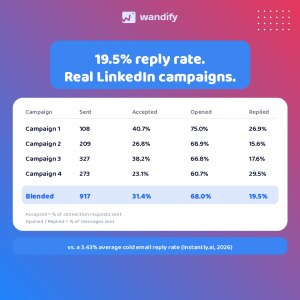
Four of Wandify’s own LinkedIn outreach campaigns, unfiltered:
Accepted is measured against connection requests sent. Opened and replied are measured against messages sent. These are Wandify’s own campaigns, not a published industry benchmark, so treat the 19.5% as one data point rather than a market average the way the Instantly.ai numbers above are.
“Sent” above is connection requests (917 total, blended). Applying the blended acceptance rate, that’s roughly 288 messages sent to people who accepted — and roughly 56 replies, the arithmetic behind the 19.5% blended reply rate. Wandify doesn’t have a published third-party methodology to compare this against; treat it as a first-party data point.
Set next to the 3.43% average cold email reply rate cited above, that’s a wide gap on paper — though the two aren’t a controlled, apples-to-apples comparison: different channel, different audience behavior, different measurement window. What they share is the mechanism this self-audit is built on: reaching the right person, with enough context for them to place you immediately, replies better than sending more messages to a colder list.
Your reply rate is a data question first
Before rewriting a subject line, run the three-question audit above. For most teams, the gap sits in list quality more than copy. A sequence rewrite alone rarely closes a targeting gap.
Start a free search and compare the contact accuracy against your current list. No credit card required.
FAQ
Does sending more follow-up emails increase reply rate?
Not reliably on its own. The same report found 58% of replies come from the first email in a sequence. If the first email isn’t reaching the right person, additional follow-ups add volume without proportionally adding replies.
What matters more: subject line or contact accuracy?
Contact accuracy has the larger effect. A well-written email to the wrong person, or to a bounced address, cannot reply. Subject-line and copy improvements matter most once the list itself is targeted and verified.
How many emails do I need to send before I trust my reply rate number?
Small samples swing widely: a 50-email batch can show 0% or 15% by chance alone. Measure reply rate against total emails sent, the same denominator the benchmark above uses, and treat 300–500 emails as a practical minimum before comparing your number to a benchmark tier — not a statistically guaranteed one.
Does personalized LinkedIn outreach get better reply rates than cold email?
In four of Wandify’s own LinkedIn outreach campaigns, the blended reply rate was 19.5%, well above the 3.43% cold email average above — though the two aren’t a controlled channel comparison. That’s internal campaign data, not a published third-party benchmark, and the underlying reason lines up with the rest of this audit: the recipient can already see who you are before they open the message, which does some of the targeting work that a cold email has to do with words alone.